Robotic Partial Knee Replacement
By Dr. Ashok Kr. Dhar in Orthopaedics & Joint Replacement
Apr 14, 2026
Robotic Partial Knee Replacement: The Future of Precision Orthopedics
Preserving Nature, Restoring Mobility at Metro Hospitals
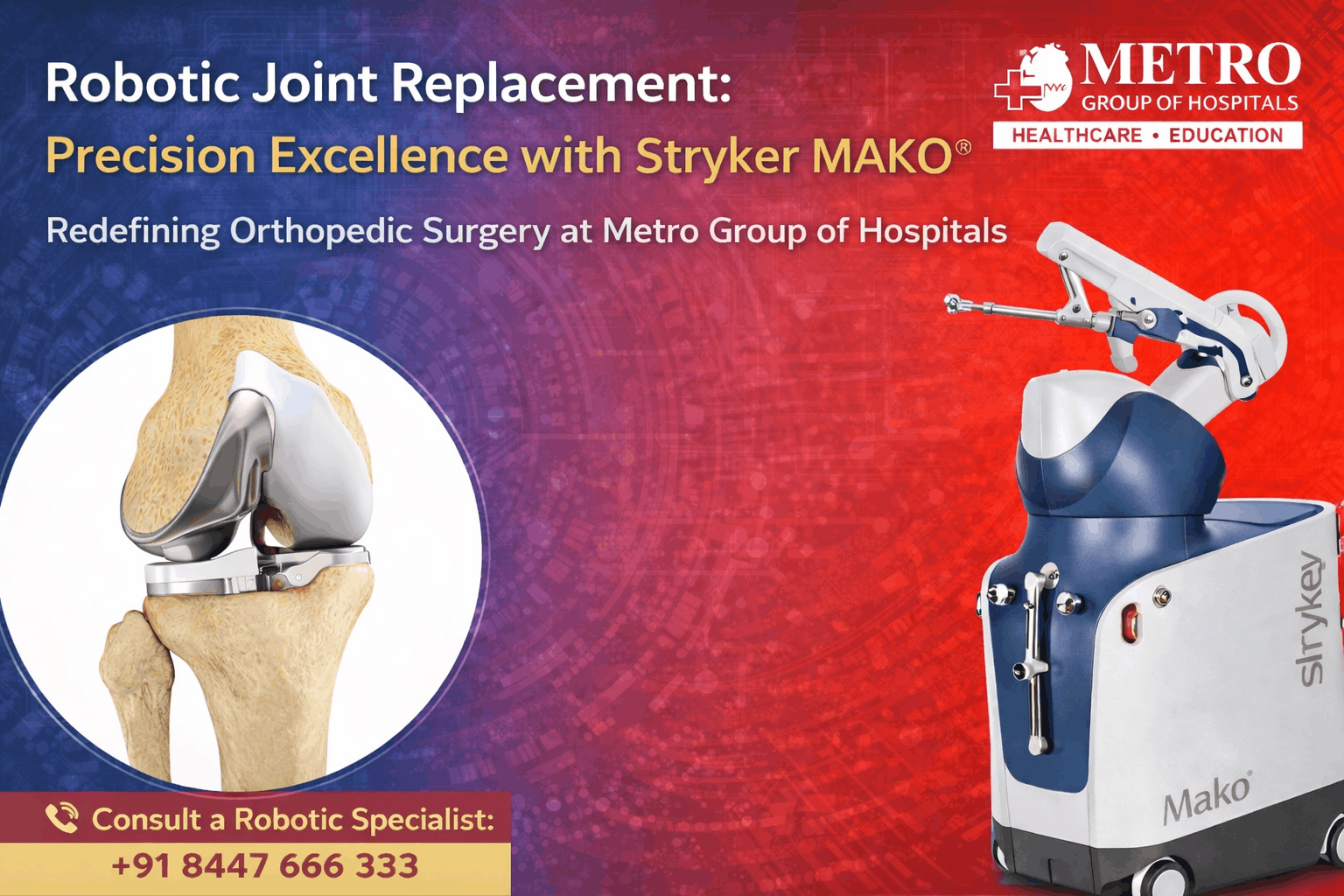
Joint replacement has evolved from “one-size-fits-all” to high-definition personalization. Robotic Partial Knee Replacement (PKR) is a revolutionary approach for patients with localized arthritis, allowing surgeons to repair only the damaged portion of the knee while leaving healthy bone and ligaments—like the ACL—completely intact.
With robotic-assisted procedures now accounting for 11% of knee surgeries globally, Metro Group of Hospitals is leading the charge in India, utilizing the latest robotic platforms to deliver sub-millimeter precision and faster recovery.
Consult a Robotic Specialist: +91 8447 666 333
What is Robotic Partial Knee Replacement?
Unlike a Total Knee Replacement (TKR) which replaces the entire joint, Robotic PKR focuses solely on the affected “compartment” (medial, lateral, or patellofemoral). By using a robotic arm as a high-precision guide, our surgeons can resurface the bone with extreme accuracy, ensuring the artificial implant fits seamlessly into your natural anatomy.
Are You a Candidate for Robotic PKR?
This procedure is an ideal “middle ground” for patients who are too active for just medication but don’t yet need a full knee replacement.
- Localized Pain: Pain confined to one specific side of the knee.
- Good Ligament Stability: Your ACL and PCL should be healthy and intact.
- Range of Motion: You still maintain a decent ability to bend and straighten the leg.
- Failed Conservative Care: You’ve tried physical therapy, weight loss, and injections without lasting relief.
Note: Those with widespread inflammatory arthritis (like Rheumatoid Arthritis) or significant deformities may be better suited for a Total Knee Replacement.
The Metro Precision Protocol: How it Works
- 3D Virtual Mapping: We start with a high-resolution CT scan to create a 3D digital twin of your knee. This allows the surgeon to plan the exact size and orientation of the implant before surgery.
- Haptic Protection: During the procedure, the robotic arm uses a “virtual boundary.” If the surgeon moves outside the planned area, the robot provides haptic feedback (resistance), ensuring zero damage to surrounding healthy tissue.
- Real-Time Alignment: The system provides live data during surgery, allowing for perfect ligament balancing so your knee feels “natural” and stable.
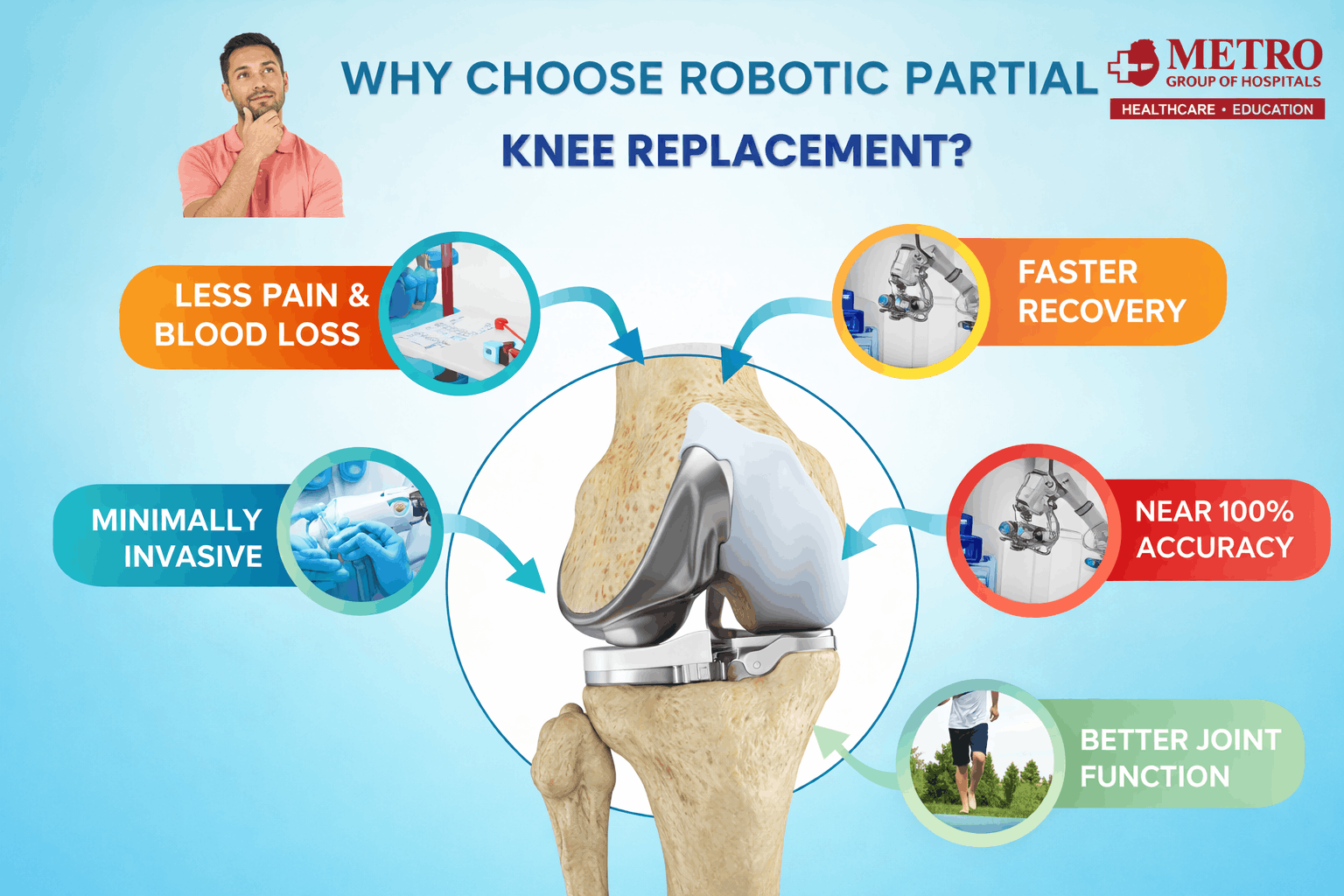
Key Benefits: Why Choose Robotic over Manual?
- Natural Joint Feel: Because we preserve your own ligaments and healthy bone, the knee retains its natural “proprioception” (the feeling of where your limb is in space).
- Sub-Millimeter Accuracy: Robotic assistance eliminates human error in bone resurfacing and implant positioning.
- Rapid Recovery: Most patients are mobile within 24 hours and return to daily activities much faster than traditional surgery.
- Increased Longevity: Precise alignment reduces uneven wear and tear, potentially extending the implant’s life to 25+ years.
Recovery & Rehabilitation at Metro Hospitals
At Metro, your surgery is only the first step. Our integrated recovery program includes:
- Early Mobilization: We get you standing and walking on Day 1 to prevent blood clots and promote healing.
- Custom Physiotherapy: A tailored exercise regime to strengthen the quadriceps and restore full range of motion.
- Advanced Pain Management: We use multi-modal analgesia and cryotherapy (cold therapy) to minimize post-op discomfort.
FAQs
1. How long does the surgery take?
A Robotic Partial Knee Replacement typically takes between 2 and 3 hours, depending on the complexity of the joint anatomy.
2. Will I need a total knee replacement later in life?
While PKR treats only the damaged area, the rest of your knee can still develop arthritis over time. However, for most patients, a well-aligned robotic PKR can last 15 to 20 years or more before any further intervention is considered.
3. Can I have both knees done simultaneously?
In specific cases, “bilateral” PKR is possible. However, our surgeons usually recommend a staggered approach to ensure the safest and most effective rehabilitation.
4. When can I drive after surgery?
Most patients return to driving within 3 to 4 weeks, provided they are no longer taking narcotic pain medication and have regained sufficient muscle control and reaction time.
5. Does robotic surgery leave a large scar?
No. Because this is a minimally invasive approach, the incision is significantly smaller (usually 3–4 inches) compared to the 8–10 inch scar typically seen in traditional total knee replacements.