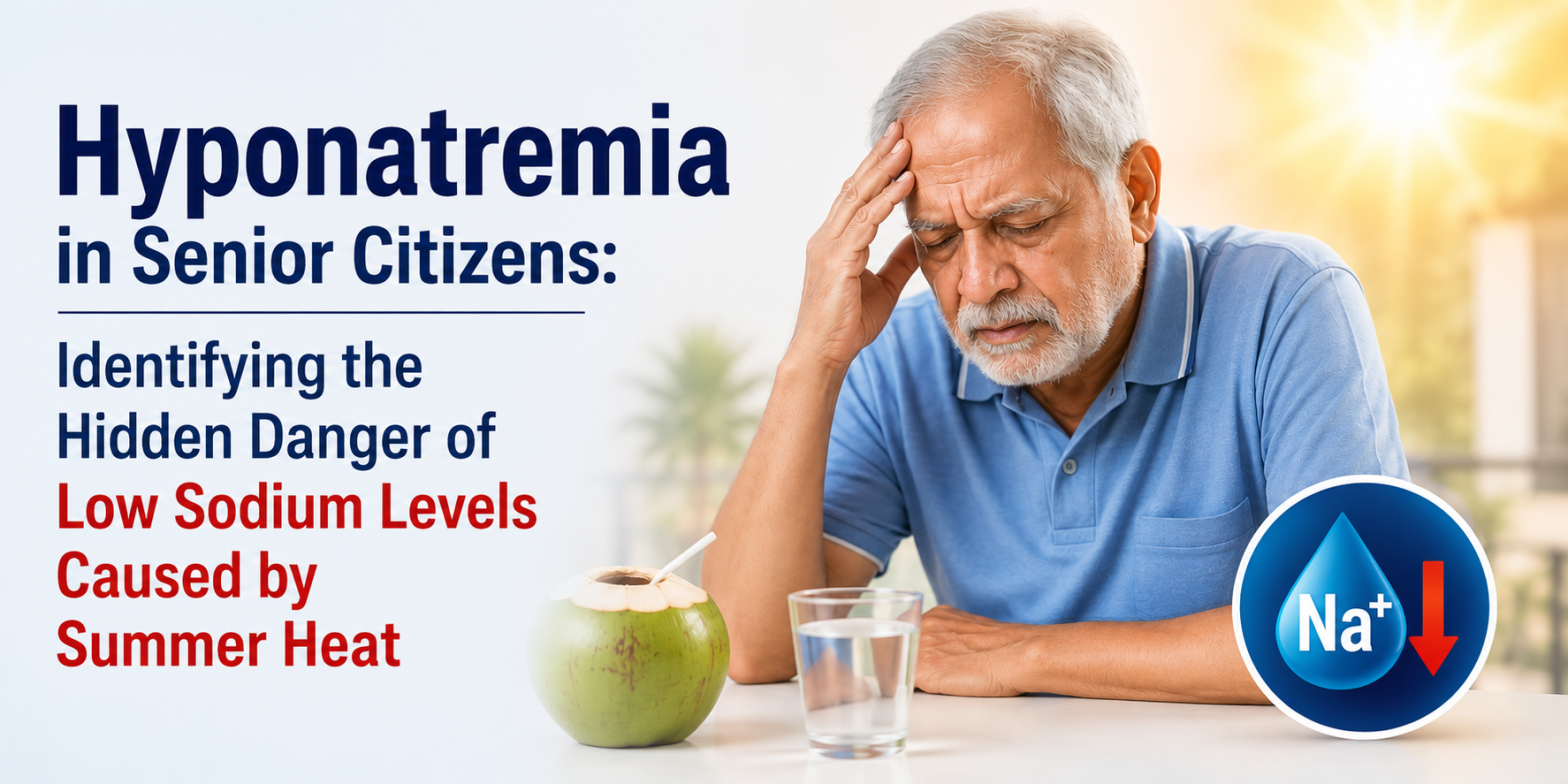
Hyponatremia in Senior Citizens: Identifying the Hidden Danger of Low Sodium Levels Caused by Summer Heat
By Dr. Akshay Chugh in Internal Medicine
May 22, 2026
Hyponatremia in Senior Citizens: Identifying the Hidden Danger of Low Sodium Levels Caused by Summer Heat
As the peak summer heatwave blankets Delhi-NCR, public health advisories rightly focus on heat exhaustion, sunburns, and hydration. However, for senior citizens, the blistering summer sun hides a less-talked-about but highly critical medical danger: Hyponatremia.
Characterized by dangerously low sodium levels in the blood, hyponatremia is a leading cause of emergency hospitalizations among the elderly during May and June. Because its initial symptoms—such as fatigue, mild confusion, and weakness—closely mimic general summer exhaustion, families often dismiss the warning signs until the condition escalates into a neurological emergency.
At Metro Hospital and Heart Institute, Noida (Sector 11 & 12), our Internal Medicine and Nephrology departments observe a sharp spike in elderly emergency admissions due to metabolic and electrolyte imbalances during hot weather. Understanding why this happens, how to identify the hidden warning signs, and knowing when to rush to the hospital can save your elderly loved ones from severe health complications.
The Physiology: Why Does Summer Heat Cause Low Sodium in the Elderly?
Sodium is an essential electrolyte that acts as a gatekeeper for your body’s fluid balance. It plays a critical role in maintaining stable blood pressure, supporting nerve function, and regulating the fluid environment inside and outside every single cell.
When the body is exposed to extreme summer temperatures, it relies on sweating to cool down. Sweat contains a mix of water and essential minerals, primarily sodium. While a young individual’s body can seamlessly adjust its hormonal and fluid balances to compensate for this loss, a senior citizen’s physiology faces multiple vulnerabilities:
- Aging Kidney Function: As we age, the kidneys naturally lose some of their efficiency in conserving sodium and concentrating urine. When an elderly person sweats during hot weather, their aging kidneys struggle to fine-tune the fluid-to-sodium ratio in the bloodstream.
- Diminished Thirst Mechanism: The brain’s natural thirst center (the hypothalamus) becomes less sensitive with age. Many senior citizens do not feel thirsty even when their body is severely dehydrated and losing sodium through sweat, leading to inadequate fluid management.
- The “Water Flushing” Trap: When seniors do drink water during a heatwave, they often drink large volumes of plain water in a short period without replacing lost minerals. This excess plain water dilutes the already low amount of sodium remaining in their bloodstream, causing a condition known as dilutional hyponatremia.
- Medication Interactions: A vast majority of senior citizens take daily medications for chronic conditions like hypertension (high blood pressure) or congestive heart failure. Medications such as diuretics (“water pills”), ACE inhibitors, and certain antidepressants force the kidneys to excrete extra water and sodium, significantly compounding the summer electrolyte drain.
Recognizing the Hidden Symptoms: It’s Not Just “Old Age Fatigue”
The true danger of hyponatremia lies in its stealthy progression. In its early stages, the symptoms are often subtle and commonly mistaken for normal aging, fatigue, or exhaustion caused by hot weather. However, as sodium levels drop further, water leaves the blood and rushes into body cells, causing them to swell. This cellular swelling is most dangerous in the brain, leading to neurological complications.
Look out for these signs, categorized by severity:
- Mild to Moderate Signs: Progressive physical weakness, a persistent feeling of lethargy, muscle cramps, loss of appetite, mild nausea, and a subtle unsteadiness while walking that increases the risk of falls.
- Severe Neurological Signs: Pronounced confusion, slurred speech, short-term memory loss, extreme drowsiness, irritability, hallucinations, and changes in personality (such as an otherwise calm person becoming suddenly aggressive or disoriented).
- Critical Medical Emergencies: If sodium levels collapse rapidly, it can lead to seizures, stupor, a loss of consciousness, or a comatose state requiring immediate life-support intervention.
Advanced Diagnostic and Therapeutic Management at Metro Hospital Noida
When an elderly patient presents with sudden confusion or severe weakness during the summer, time is of the essence. At Metro Hospital Noida, our dedicated Emergency and Critical Care teams follow a highly precise clinical protocol to diagnose and manage electrolyte imbalances.
- Rapid Metabolic Profiling: Upon arrival, a quick blood draw is performed to run an Emergency Electrolyte Panel, measuring precise levels of Sodium ($Na^+$), Potassium ($K^+$), and Chloride ($Cl^-$), alongside kidney function parameters.
- Meticulous Fluid Regulation: Treating hyponatremia is a delicate medical art. Raising sodium levels too quickly can cause irreversible damage to the brain’s nerve sheaths (a condition called Central Pontine Myelinolysis). Our expert internal medicine specialists and nephrologists calculate precise intravenous (IV) fluid adjustments using specialized saline concentrations, raising sodium levels safely and gradually under continuous ICU or high-dependency monitoring.
- Medication Calibration: Our clinical team thoroughly reviews the patient’s existing prescription sheets to safely modify or pause blood pressure medications and diuretics that may be causing the electrolyte depletion.
Preventive Summer Care Checklist for Caregivers
Preventing hyponatremia does not mean restricting water; rather, it means practicing smart, balanced hydration. Caregivers can protect seniors by implementing these practical steps:
- Incorporate Electrolyte-Rich Fluids: Do not rely solely on plain water. Introduce balanced fluids like coconut water, freshly prepared lemonade (nimbu paani) with a pinch of salt, light buttermilk (chaas), or commercial Oral Rehydration Salt (ORS) solutions throughout the day.
- Monitor the Indoor Environment: Ensure that senior citizens sit in well-ventilated or air-conditioned rooms during peak sunshine hours (11:00 AM to 4:00 PM) to minimize excessive, unnoticed sweating.
- Routine Blood Tests: If your elderly parents are on regular blood pressure medications or diuretics, schedule a routine serum electrolyte blood test at the beginning and middle of the summer season to catch dropping sodium trends early.
Frequently Asked Questions (FAQs)
Q1. Can we just give salt water to an elderly person showing signs of confusion?
No. Sudden, uncontrolled intake of high-salt solutions can dangerously spike blood pressure or cause fluid to accumulate in the lungs, especially if the patient has underlying heart or kidney conditions. Always consult a doctor or visit an emergency room for a proper blood analysis before administering heavy salt corrections.
Q2. Is treatment for hyponatremia covered under government medical panels at Metro Noida?
Yes. Metro Hospital Noida is proudly empanelled with leading public healthcare schemes, offering completely cashless treatment facilities for CGHS, DGHS, ECHS, and ESIC cardholders, alongside major corporate health insurances. Our dedicated panel help desk ensures smooth, zero-delay pre-authorizations for emergency admissions.
Q3. How long does it take for a patient to recover from low sodium?
With appropriate, controlled IV fluid therapy and medical monitoring, most senior citizens begin to show significant neurological improvement and structural recovery within 24 to 48 hours of admission.