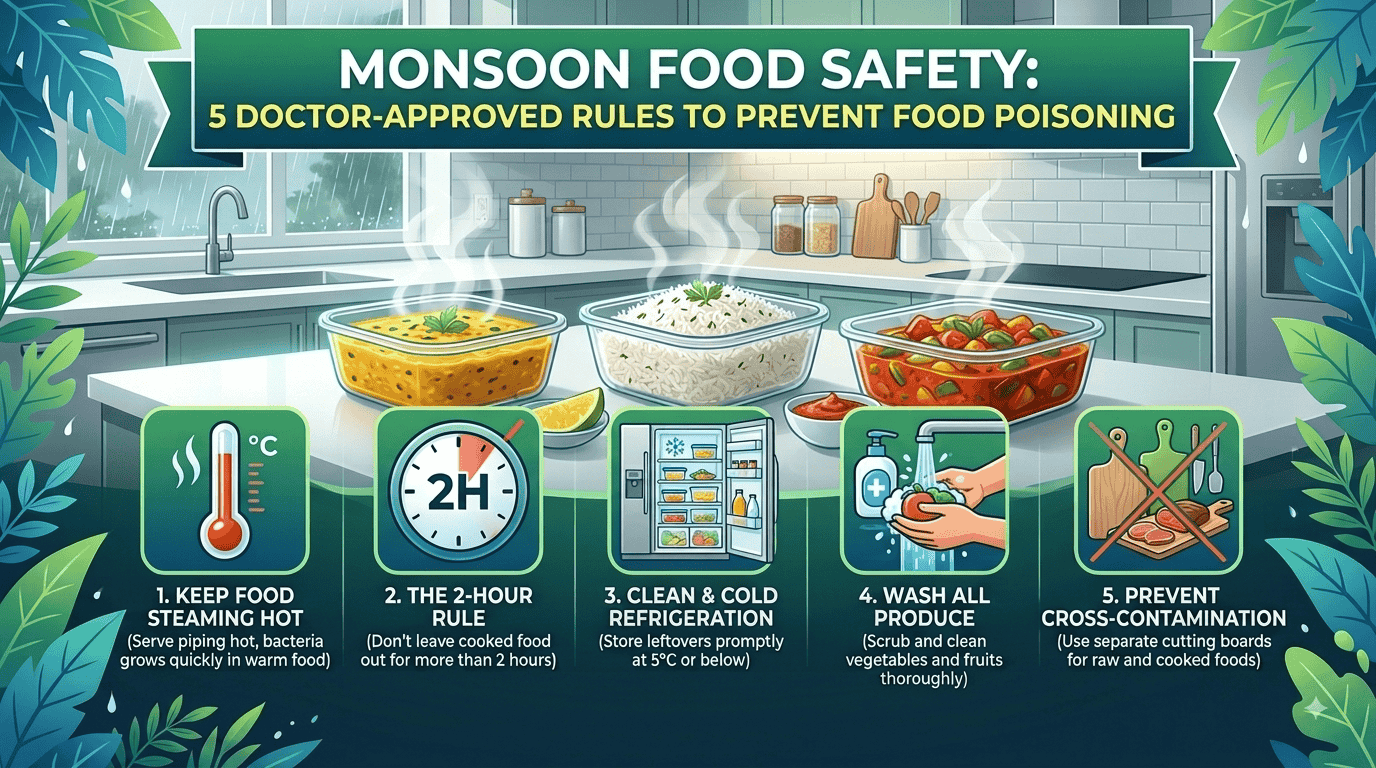
Is Reheated Monsoon Food Safe? 5 Doctor-Approved Rules to Prevent Food Poisoning
By Dr. Akshay Chugh in Internal Medicine
Aug 17, 2026
Is Reheated Monsoon Food Safe? 5 Doctor-Approved Rules to Prevent Food Poisoning
Monsoon brings a welcome relief from scorching summer heat, but it also causes a sharp spike in stomach infections, viral gastroenteritis, and food poisoning across Delhi NCR, Noida, Greater Noida, and Ghaziabad. While most people attribute stomach bugs to street food or contaminated municipal water, a hidden culprit often lies inside our homes: improperly stored and reheated leftover food.
During the rainy season, relative humidity in regions like Noida, Delhi, and Gurgaon frequently crosses 80% to 90%. High humidity creates a thriving environment for airborne fungal spores and disease-causing bacteria, including Salmonella, E. coli, and spore-forming Bacillus cereus.
So, is reheated monsoon food safe? The short answer is yes—but only if you follow strict temperature control and food hygiene practices. Simply warming up food until it is lukewarm does not kill bacteria; in fact, it accelerates bacterial growth and can lead to severe toxic food infections requiring emergency hospital care.
To keep your family safe this rainy season, here are 5 doctor-approved rules for reheating food, along with essential local health FAQs.
1. The “2-Hour Limit”: Pack Away Cooked Food Promptly
Food safety begins long before leftovers enter the pan or microwave. When hot food sits on a kitchen counter in humid North Indian weather, it rapidly enters the “Danger Zone”—the temperature range between 4°C and 60°C (40°F to 140°F).
In humid monsoon conditions across Noida and Delhi NCR, bacteria double in count every 15 to 20 minutes within this temperature zone.
- The Rule: Never leave cooked food at room temperature for more than 2 hours. If your kitchen is hot and humid (above 30°C), reduce this limit to 1 hour.
- Pro-Tip: Do not wait for a large pot of hot dal or curry to cool completely before refrigerating. Transfer cooked items into shallow, sealed containers to speed up cooling. Shallow containers allow heat to dissipate much faster inside the refrigerator, preventing microbial multiplication.
2. Reheat to Piping Hot (Minimum 75°C / 165°F)
Gentle warming or taking the chill off refrigerated food isone of the primary causes of monsoon food poisoning. Low heat creates a warm, moist environment where surviving bacteria multiply exponentially.
- The Rule: Always reheat leftovers until they are steaming hot throughout. Liquid dishes like soups, gravies, and dals must be brought to a full rolling boil for at least 1 to 2 minutes. Solid foods should reach an internal temperature of at least 75°C (165°F).
- Microwave Precautions: Microwaves heat food unevenly, leaving hidden “cold spots” where bacteria survive. Always cover your dish, pause midway through heating to stir thoroughly, and let it rest for 2 minutes to allow uniform heat distribution before eating.
3. Practice the “Single Reheat” Rule
Repeatedly heating, cooling, and re-refrigerating the same pot of food breaks down nutritional value, ruins food texture, and exponentially increases contamination risks.
When food passes through the danger zone multiple times, bacterial spores—such as Bacillus cereus spores commonly found in rice, khichdi, and grains—can germinate and produce heat-stable toxins. Once these toxins form, even boiling the food will not destroy them.
- The Rule: Reheat only the exact portion you intend to eat immediately.
- Pro-Tip: Scoop out your required serving from the refrigerator, reheat it thoroughly, and leave the remaining portion untouched in the fridge. Any food left on your plate after eating should be discarded, not put back in the refrigerator.
Also Read: Heart Health & Winter
4. Know Which High-Risk Foods Need Extra Care
Not all foods react the same way to storage and reheating. Certain staples in Indian households are notoriously unstable during the monsoon and require special attention:
| Food Item | Primary Biological / Chemical Risk | Safe Monsoon Handling Rule |
| Cooked Rice & Khichdi | High risk of Bacillus cereus spores that produce heat-resistant toxins. | Cool quickly and refrigerate within 1 hour. Reheat until steaming hot. Consume within 24 hours. |
| Green Leafy Vegetables (Palak, Methi) | High nitrate content can convert into harmful nitrites when reheated repeatedly. | Finish cooked leafy greens fresh. Avoid reheating them multiple times. |
| Paneer, Mushrooms & Eggs | Rich in proteins, these foods spoil rapidly and produce bacterial toxins that trigger severe stomach illness if improperly stored. | Consume immediately after preparation. Reheat thoroughly only once if stored under 4°C. |
| Chicken, Fish & Seafood | High moisture levels in the air trigger fast microbial contamination, drastically shortening the shelf life of these foods. | Ensure internal reheating temperature reaches 75°C. Discard if stored past 48 hours. |
5. Maintain Strict Refrigerator Hygiene & Prevent Cross-Contamination
A safe reheating routine depends heavily on refrigerator cleanliness. Moisture and power fluctuations in NCR during heavy rains can cause fridge temperatures to drop, promoting invisible mold growth.
- The Rule: Keep your refrigerator temperature set strictly at 4°C (40°F) or below, and your freezer at -18°C (0°F).
- Cross-Contamination Prevention: Always store cooked leftovers on the top shelves in glass or food-grade airtight containers. Store raw vegetables, unwashed produce, and raw meats on lower shelves. This prevents raw juices or soil spores from dripping onto ready-to-eat food.
Also Read: Viral Fever in the Rains: When to Rest at Home vs. When to Visit a Doctor
Frequently Asked Questions (FAQs)
Q1. Is it safe to eat reheated street food or takeaway in Delhi NCR during the monsoon?
It is best to avoid reheating takeaway street food during the monsoon. Food prepared in open stalls often carries initial bacterial contamination due to ambient humidity and exposure. Reheating at home may not destroy heat-resistant toxins already present in stale street food.
Q2. How long can I store cooked food in the fridge during the monsoon in Noida/Delhi?
Due to high humidity and occasional power outages in Delhi NCR, cooked food should not be stored for more than 24 to 48 hours in the refrigerator during the rainy season. Grains like cooked rice and spinach dishes are best consumed within 24 hours.
Q3. Why does eating reheated rice cause stomach upset or food poisoning?
Cooked rice contains spores of Bacillus cereus, a bacterium that survives normal cooking. If rice is left sitting at room temperature, these spores grow into bacteria that produce heat-resistant toxins. Reheating the rice kills the bacteria but does not destroy the toxins, leading to severe nausea and vomiting (Fried Rice Syndrome).
Q4. Can power outages in monsoon affect food stored in the refrigerator?
Yes. If a power outage lasts longer than 2 to 4 hours, the internal refrigerator temperature rises into the Danger Zone (>4°C). Keep the fridge doors closed as much as possible during power cuts. If perishable leftovers stay above 4°C for more than 2 hours, discard them.
Q5. When should I consult a doctor or visit a hospital for food poisoning in Delhi NCR?
Seek immediate medical attention at a gastroenterology or emergency facility if you experience severe symptoms such as continuous vomiting, high fever (above 101°F), blood in stool, severe abdominal pain, or signs of dehydration (extreme thirst, dry mouth, or dark urine).
Summary Checklist for Monsoon Leftovers
- Refrigerate early: Store cooked food within 1–2 hours.
- Heat thoroughly: Bring gravies to a rolling boil; heat solids to 75°C.
- Portion out: Reheat only what you will eat right now.
- Single reheat only: Never re-refrigerate already reheated leftovers.
- Trust your senses: If leftover food smells sour, looks slimy, or shows color changes, discard it immediately—never taste-test questionable food.