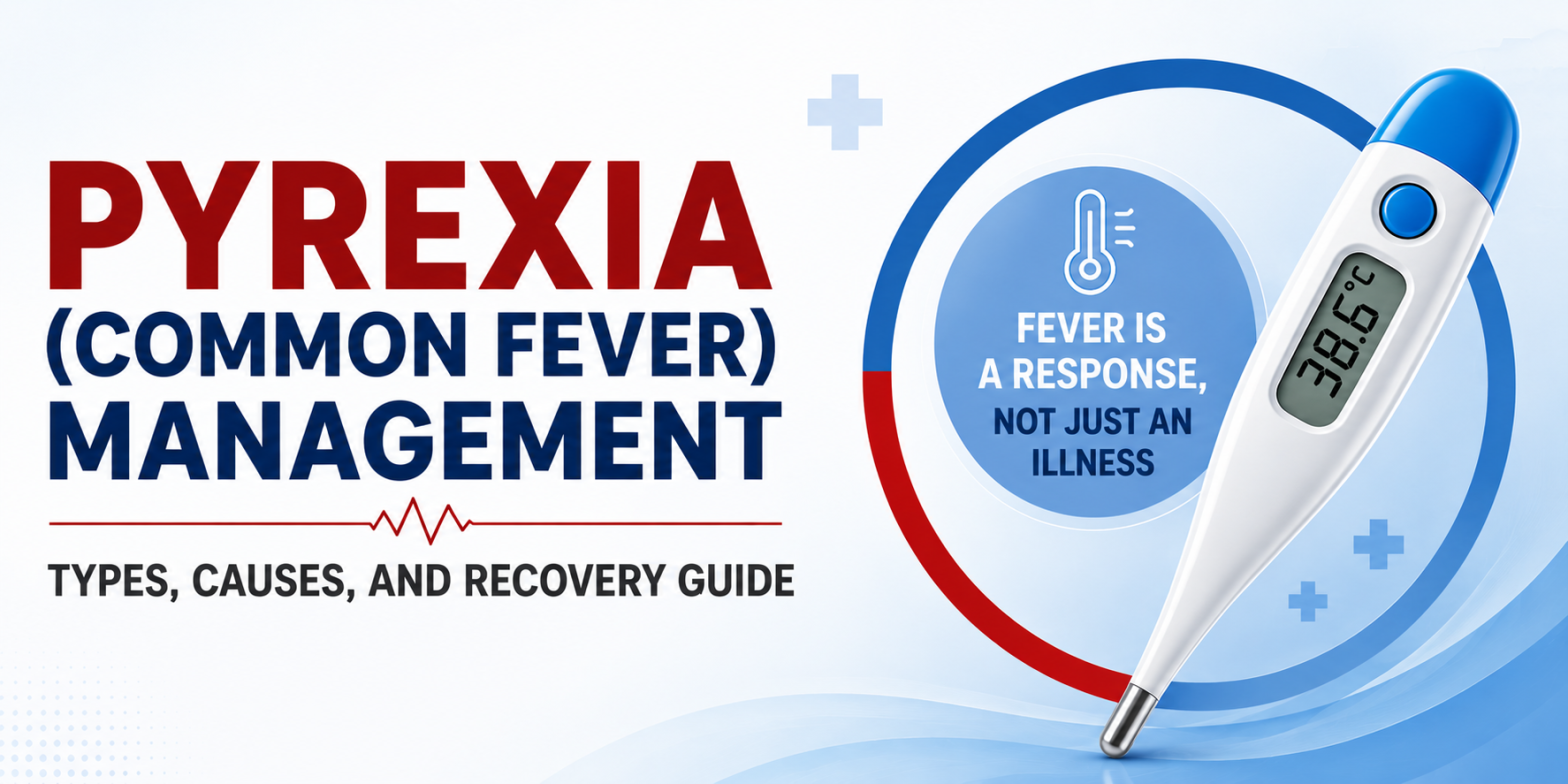
Pyrexia (Common Fever) Management
By Dr. Akshay Chugh in Internal Medicine
Jun 27, 2026
Pyrexia (Common Fever) Management: Types, Causes, and Recovery Guide
Introduction: The Evolution of Measuring Fever
For over a century, clinical medicine relied heavily on the 19th-century research of German physician Carl Reinhold August Wunderlich, who established 37.0°C (98.6°F) as the standard baseline for normal human body temperature. Anyone exceeding this limit was historically classified as having a fever.
Modern clinical research, however, offers a more dynamic understanding. Normal baseline body temperature naturally fluctuates throughout the day—typically hitting its lowest point in the early morning and peaking in the late afternoon. Today, a normal temperature range is clinically recognized between 36.4°C and 37.2°C (97.5°F to 98.9°F).
According to Dr. Akshay Chugh, Consultant at Metro Hospital, Noida: “A patient is medically considered to have a true clinical fever when their core body temperature crosses 38°C (100.4°F). Fever is not an isolated disease; it is a prolonged physiological response where your body actively elevates its temperature to create a hostile environment for invading pathogens.”
What is Pyrexia?
Pyrexia is the formal medical term for a fever. It represents a controlled clinical condition where the brain’s temperature regulatory center—located within the hypothalamus gland—temporarily resets the body’s target set-point upward.
While experiencing a fever can feel uncomfortable, it is primarily a defensive mechanism. Pyrexia serves as your immune system’s frontline acceleration tool, triggering metabolic changes that help white blood cells systematically neutralize viral, bacterial, or fungal infections.
The 5 Clinical Types of Pyrexia
The precise behavioral pattern of a fever provides internal medicine specialists with vital diagnostic clues regarding the underlying infection. If you are tracking a fever at home, keeping an accurate hourly log of these temperature shifts is highly beneficial.
1. Intermittent Fever
In an intermittent pattern, the patient’s body temperature spikes significantly—often during evening hours—but returns entirely to the baseline normal range (37.0°C) at least once within a 24-hour cycle. This variation is frequently documented in localized bacterial infections or specific parasitic conditions.
2. Remittent Fever
A remittent fever keeps the body temperature continuously elevated above normal limits throughout a 24-hour window. While the temperature undergoes distinct, noticeable fluctuations over the day, it never drops all the way back down to baseline.
3. Hectic Fever
Characterized by extreme, dramatic sweeps between its highest peak and lowest troughs within the same day. These sharp thermal swings are typically accompanied by rigorous shaking chills (rigors) followed by profound, drenching sweats as the temperature temporarily plunges.
4. Continuous (Sustained) Fever
A continuous fever is a persistent, unchanging state of high body temperature. The readings remain elevated with minimal fluctuations (typically less than 1°C variance) across a 24-hour duration, often pointing to systemic bacterial issues like Typhoid fever.
5. Relapsing Fever
This type manifests as an intermittent fever sequence that appears to clear up completely, keeping the patient’s temperature normal for several days or weeks, only to suddenly relapse into another high-grade fever cycle.
Core Causes and Biological Triggers of Fever
The master regulator of your internal temperature is the hypothalamus gland in the brain. When immune cells detect a disease or foreign threat, they release biochemical signaling substances called pyrogens. These pyrogens command the hypothalamus to raise core body heat.
Common Triggers of Pyrexia
- Viral Infections: Pathogens like the common cold, seasonal Influenza, Norovirus, Rotavirus, Dengue, and Chikungunya.
- Bacterial Pathogens: Systemic or localized bacterial invasions including Salmonella (Typhoid), E. coli (Urinary Tract or Gut Infections), and Shigella.
- Environmental Stress: Severe dehydration, heat exhaustion, or heatstroke can disrupt internal thermal regulation, spiking a fever.
- Oncological Factors: Specific malignancies, such as Hodgkin’s lymphoma, acute myeloid leukemia, and renal cell carcinoma, can present with recurrent fevers.
- Drug-Induced Pyrexia: A direct adverse reaction or acute allergic response to specific pharmacological medications.
- Immunization Responses: Mild, low-grade fevers are common temporary reactions to childhood vaccines (like DPT) or adult immunizations.
- Transfusion Reactions: Acute immune system responses following a blood transfusion.
Identifying the Accompanying Symptoms of Pyrexia
A spike in core temperature rarely occurs alone. Recognizing associated symptoms helps doctors determine the underlying pathology:
- Skin Flushing: The skin feels noticeably hot to the touch or appears visibly reddened as blood vessels dilate.
- Tachycardia: An elevated heart rate or a sensation of rapid chest palpitations.
- Rigors and Chills: Involuntary shivering, shaking, or feeling intensely cold despite a rising core temperature.
- Musculoskeletal Pain: Generalized muscle aches, joint pains, and profound physical fatigue.
- Neurological Distress: Intense headaches, dizziness, and at very high temperatures, confusion or temporary hallucinations.
- Pediatric Sub-symptoms: Infants may display relentless crying, extreme fussiness, diarrhea, or in vulnerable age groups, febrile seizures.
Clinical Risk Factors and Potential Complications
While a mild fever is generally manageable, a prolonged, high-grade fever crossing 40°C (104°F) poses serious clinical risks, particularly to specific demographics.
Major Risk Categories
- Individuals with compromised immune systems due to conditions like uncontrolled diabetes, active cancer treatments, or chronic lung diseases.
- Infants under 3 months of age and the elderly, as their immune systems are more vulnerable to rapid deterioration.
- Prolonged exposure to individuals with known infectious contagious diseases while suffering from nutritional malnourishment.
Associated Complications
- Febrile Seizures: Convulsions triggered by rapid temperature spikes, most commonly seen in children under 5 years old.
- Neurological Strain: Severe untreated high-grade pyrexia can cause deep disorientation and, in rare instances, neurological complications.
- Metabolic Shock: If left completely unchecked, an escalating fever combined with extreme dehydration can lead to critical organ strain.
Systematic Protocol for Professional First Aid and Treatment
To manage pyrexia effectively without complications, follow this structured treatment approach:
1.Accurate Thermal Tracking: Every 1-2 Hours.
Use a calibrated digital clinical thermometer to record the exact temperature. Keep a written log of the timestamps and readings to share with your physician.
2.Initiate Supportive External Cooling: Immediate Relief.
Apply a clean, damp cloth soaked in lukewarm water to the patient’s forehead, wrists, and armpits. Do not use ice water, as it can cause shivering and drive the core temperature higher.
3.Aggressive Oral Rehydration: Fluid Correction.
Administer fresh coconut water, clear broths, or an Oral Rehydration Solution (ORS) to offset fluid loss from sweating and prevent dehydration.
4.Targeted Medical Intervention: Under Doctor Guidance.
Consult an Internal Medicine specialist to obtain precise antipyretics or targeted antibiotics/antivirals. Avoid self-prescribing heavy antibiotics, which can mask underlying infections.
Dietary Recommendations During Pyrexia
| Recommended Foods (Include) | Rationale | Foods to Avoid (Exclude) | Rationale |
| Clear Broths, Soups, & ORS | Replaces vital electrolytes and lost fluids. | Heavy Dairy (Full-Cream Milk/Cheese) | Difficult for an inflamed GI tract to digest. |
| Vitamin C Fruits (Oranges/Melons) | Supplies antioxidants to boost immune function. | Caffeinated Beverages & Alcohol | Accelerates systemic dehydration and strains the kidneys. |
| Light Proteins (Moong Dal Khichdi) | Provides clean energy without straining the gut. | Red Meat & Deep-Fried Dishes | Causes metabolic heat and slows down recovery. |
When to Seek Immediate Medical Emergency Care
Most mild fevers run their course and resolve within 48 to 72 hours with rest and hydration. However, you must seek professional medical attention at a dedicated multi-specialty facility like Metro Hospital if the following criteria are met:
For Infants (Under 3 Months)
- Any temperature spike crossing 38°C (100.4°F) is a strict medical emergency. Contact a pediatrician immediately if you note relentless crying, a lack of urination for over 4 hours, or unusual sluggishness.
For Children (Up to 5 Years)
- Persistent high-grade fevers accompanied by extreme lethargy, an absolute refusal to consume fluids, repeated vomiting, a distended abdomen, or signs of an involuntary febrile seizure.
For Adults
- A high fever crossing $39.4°C (103°F) that remains unresponsive to medication or persists past 3 to 4 days.
- The presence of danger signs: severe chest pain, breathing difficulties, an unrelenting headache, a stiff neck, or mental disorientation.
CRITICAL CLINICAL ALERT: High fever in young children must be managed carefully. If a child’s temperature rises rapidly, begin immediate lukewarm whole-body sponging to protect their vitals and transport them to the nearest Metro Hospital Emergency Wing for professional clinical evaluation.
Frequently Asked Questions (FAQs) – Pyrexia & Fever Treatment
Q1: What is the clinical difference between a normal fever and Pyrexia?
A: There is no difference; “Pyrexia” is simply the formal medical term for a fever. It describes an elevated body temperature above the normal range (typically crossing 100.4°F or 38°C which is triggered by the brain’s hypothalamus gland as a defense mechanism against infection.
Q2: Which hospital is best for the diagnosis and treatment of prolonged fever or PUO in Noida?
A: Metro Hospital (Sector 11, Noida) is widely recognized for its advanced Internal Medicine and Infectious Disease department. Backed by fully automated pathology labs, Senior Consultants like Dr. Akshay Chugh provide high-precision differential diagnosis for complex fevers, Typhoid, Dengue, and Pyrexia of Unknown Origin (PUO).
Q3: When should an adult seek immediate hospital care for a fever?
A: An adult should visit the emergency wing of a multi-specialty hospital like Metro Hospital immediately if the fever crosses 103°F (39.4°C), remains unresponsive to medication for over 3 days, or is accompanied by “red flag” symptoms like breathing difficulties, severe chest pain, a stiff neck, or mental confusion.
Q4: Why does a high fever cause shivering and chills?
A: When an infection enters the body, the hypothalamus resets your internal thermostat to a higher target temperature (e.g., 102°F). Because your current body temperature is still at 98.6°F, your brain perceives the body as cold, triggering shivering and chills to rapidly generate metabolic heat.
Q5: Can high fever in young children cause seizures? How can it be prevented?
A: Yes, rapid temperature spikes in children under the age of 5 can cause febrile seizures. To prevent this, immediately start whole-body sponging with lukewarm water (never use ice water) to lower the skin temperature safely, and consult a pediatrician at Metro Hospital at the earliest.
Q6: Why should we avoid self-medicating with antibiotics during a common viral fever?
A: Antibiotics are designed exclusively to kill bacteria; they have absolutely no effect on viral infections like Influenza or Dengue. Self-medicating can lead to antibiotic resistance, upset your stomach microbiome, and mask crucial clinical symptoms, making an accurate medical diagnosis difficult.