Dengue or Seasonal Flu? How to Spot the Differences and Manage Platelets Safely
By Dr. Saibal Chakravorty in Internal Medicine
Aug 13, 2026
Dengue or Seasonal Flu? How to Spot the Differences and Manage Platelets Safely
With the arrival of the monsoon season across North India, outpatient departments (OPDs) see a sharp increase in patients presenting with acute febrile illnesses. During this time, a common dilemma faced by clinicians and patients alike is distinguishing between routine viral fever—commonly referred to as the Seasonal Flu—and Dengue Fever.
Because both conditions share initial symptoms such as sudden onset of high body temperature, generalized weakness, and body aches, late or incorrect identification can lead to unnecessary panic—particularly regarding dropping platelet counts.
Understanding the distinct clinical pathways of both illnesses, knowing when to order diagnostic tests, and following evidence-based protocols for platelet management can ensure a safe and smooth recovery.
Understanding the Clinical Pathways: Dengue vs. Seasonal Flu
While both illnesses are viral in origin, the causative agents and their progression in the human body differ fundamentally.
- Seasonal Flu (Influenza): Primarily a viral respiratory infection (caused by Influenza A or B viruses) that spreads via airborne droplets. It primarily targets the upper and lower respiratory systems, causing symptoms like congestion, sore throat, and cough.
- Dengue Fever: A vector-borne viral infection caused by any of the four serotypes of the Dengue Virus (DENV-1 to DENV-4). It is transmitted through the bite of an infected female Aedes aegypti mosquito and causes systemic inflammation, capillary permeability changes, and transient bone marrow suppression.
Key Symptom Comparison
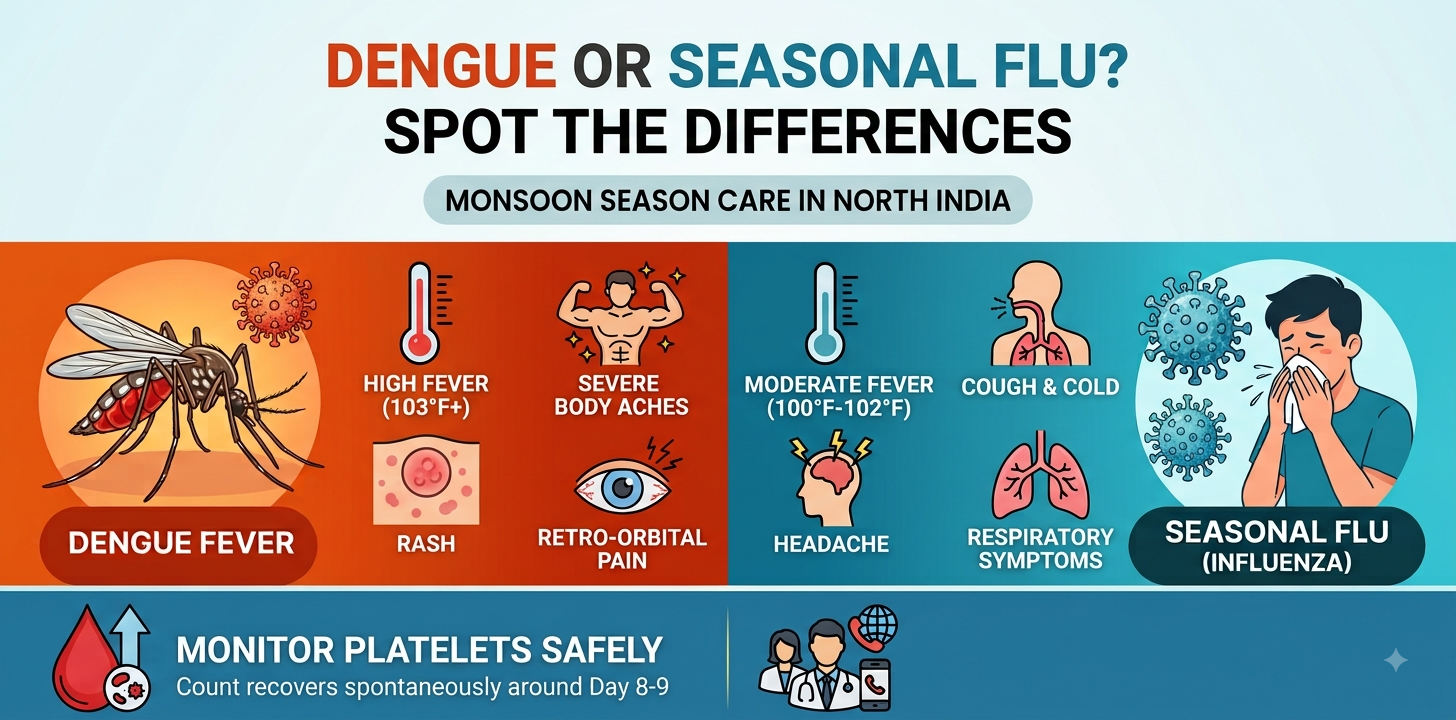
| Clinical Marker | Seasonal Flu (Influenza) | Dengue Fever |
| Onset & Pattern | Sudden to moderate onset (100°F–102°F). | Acute, high-grade spike (103°F–105°F). |
| Respiratory Symptoms | Prominent: Sore throat, cough, runny nose, nasal congestion. | Absent or minimal in initial stages. |
| Body & Muscle Pain | Moderate generalized aches. | Severe, intense joint and muscle pain (Breakbone Fever). |
| Ocular Pain | Mild burning or watery eyes. | Classic retro-orbital pain (pain behind the eyes when moving them). |
| Skin Rash | Extremely rare. | Fine maculopapular rash appearing 2 to 5 days after fever onset. |
| Platelet & Hematocrit Changes | Counts remain stable. | Platelet decline occurs typically between Day 3 and Day 7. |
The Medical Truth About Falling Platelet Counts in Dengue
In a healthy person, a normal platelet count typically stays between 1.5 lakh and 4.5 lakh ( to
) per microliter of blood. During a dengue infection, two main mechanisms cause platelets to drop:
- Bone Marrow Suppression: The virus temporarily suppresses the bone marrow, reducing platelet production.
- Peripheral Destruction: Circulating platelets are destroyed at an accelerated rate due to immune system responses and binding to viral proteins.
Evidence-Based Platelet Management Rules
- Avoid Platelet Panic: A drop in platelet count between Day 3 and Day 7 of dengue is a predictable physiological phase. Counts typically reach their lowest point around Day 6 or 7 and begin to recover spontaneously by Day 8 or 9 as the virus clears.
- When Is Transfusion Actually Required?
According to standard WHO and national clinical protocols, a low platelet number alone (e.g., 25,000 or 35,000/µL) does not automatically justify a platelet transfusion. Transfusions are generally indicated only when:
- Platelet levels drop below 10,000 to 20,000/µL without bleeding, or
- There is evidence of active, severe mucosal bleeding (e.g., blood in vomit, stool, or gums) regardless of the count.
- Hydration Over Home Remedies:
The primary complication in severe dengue is Plasma Leakage leading to fluid shift and potential shock—not platelet loss alone. Maintaining optimal fluid volume is the cornerstone of treatment. Patients should consume 3 to 4 liters of oral fluids daily, including Oral Rehydration Salts (ORS), coconut water, clear broths, and buttermilk.
- Caution Regarding Herbal Extracts:
While raw papaya leaf extracts are popular, unstandardized home preparations can trigger severe gastritis, vomiting, and acid reflux, which can complicate clinical evaluation. Always discuss supplementary intake with your treating physician.
- Absolute Ban on NSAIDs (Painkillers):
Never administer Aspirin, Ibuprofen, Mefenamic Acid, or Diclofenac for fever or pain management in suspected dengue. Non-Steroidal Anti-Inflammatory Drugs (NSAIDs) interfere with platelet function and blood clotting, significantly increasing the risk of internal gastrointestinal hemorrhage. Paracetamol is the only safe antipyretic when taken under medical guidance.
Critical Red Flags: When to Visit the ER Immediately
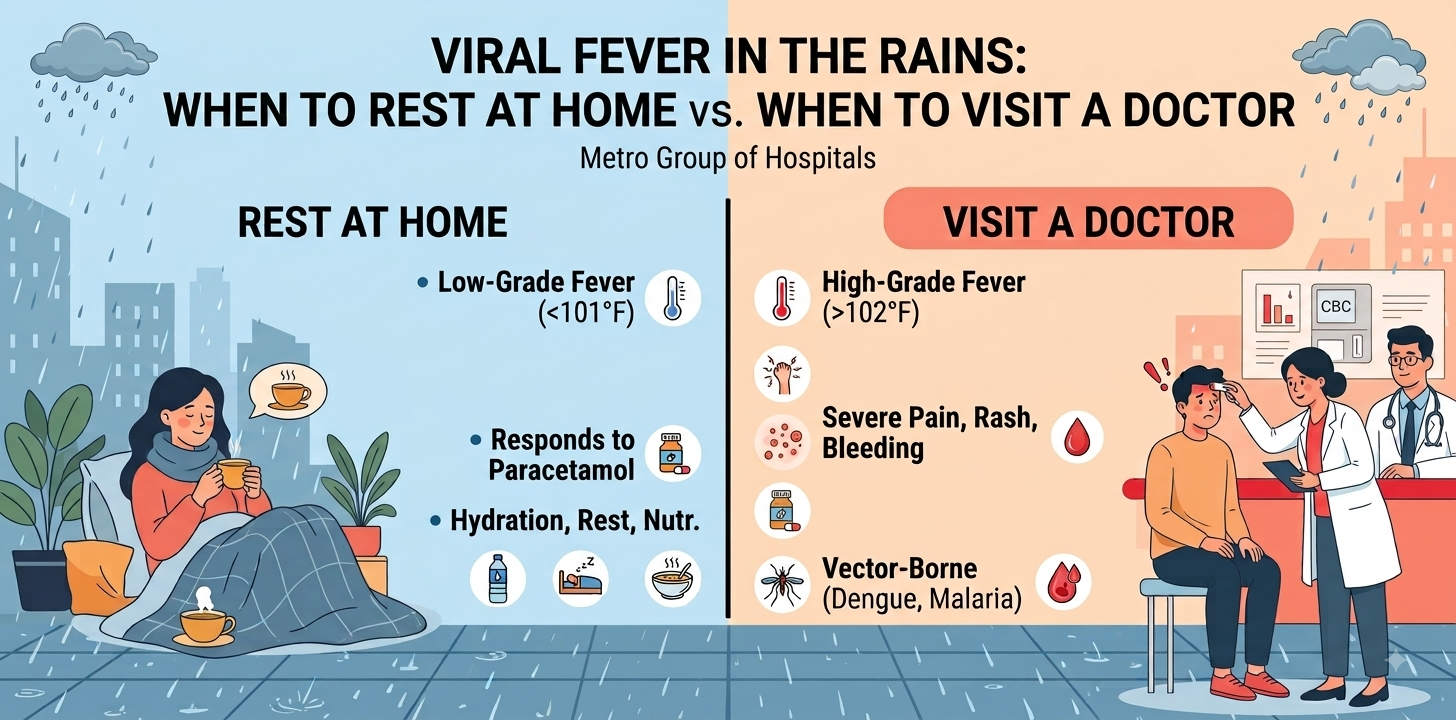
While over 85% of dengue cases resolve with home hydration and bed rest, 5% to 10% can transition into Severe Dengue (Dengue Hemorrhagic Fever or Dengue Shock Syndrome).
If any of the following “Red Flag” symptoms manifest—especially during the defervescence phase (when the fever drops between Day 3 and Day 6)—seek immediate hospital emergency care:
- Severe, unremitting abdominal pain or tenderness.
- Frequent or persistent vomiting (vomiting more than 3 times in a single day).
- Bleeding from gums, nose, or subcutaneous skin spots (petechiae).
- Drowsiness, extreme lethargy, or restlessness.
- Cold, clammy skin and rapid, shallow breathing.
Timely Diagnostics for Accurate Diagnosis
To avoid misdiagnosis and delayed care, doctors recommend targeted testing based on fever duration:
- Days 1 to 3 of Fever: Complete Blood Count (CBC) and Dengue NS1 Antigen Test.
- Day 5 Onward: Dengue IgM / IgG Antibody Test.
- If Flu Is Suspected: Influenza A/B Rapid Antigen or RT-PCR tests if upper respiratory congestion dominates.
Doctor’s Final Advice
Both seasonal flu and dengue are manageable conditions when identified early and treated with proper medical guidance. Protect yourself against vector-borne threats by wearing full-sleeved clothing, using insect repellents, and ensuring no standing water accumulates around your home. If you develop a high fever during the rainy season, prioritize oral fluids, avoid self-medication with painkillers, and consult a medical practitioner for timely CBC monitoring.
Frequently Asked Questions (FAQs)
Q1. How can I differentiate between Dengue and Seasonal Flu in Delhi-NCR during monsoon?
Answer: The main difference lies in symptom presentation. Seasonal Flu usually comes with upper respiratory symptoms like a runny nose, sore throat, and cough. In contrast, Dengue is characterized by sudden high fever, intense joint/muscle pain (breakbone fever), pain behind the eyes (retro-orbital pain), and a potential drop in platelet count after Day 3, without typical cold symptoms.
Q2. What is a dangerously low platelet count in Dengue, and when is hospital admission needed?
Answer: A normal platelet count ranges from 1,500,000 to 450,000/µL. In dengue, counts dropping below 50,000 require close medical monitoring. However, hospital admission or platelet transfusion is typically necessary only if platelets drop below 10,000–20,000/µL or if there are active signs of bleeding (like nosebleeds, bleeding gums, or blood in stool/vomit).
Q3. Which tests should I get done for high fever during the rainy season in Noida/Delhi-NCR?
Answer: For fever within the first 1 to 3 days, doctors recommend a Complete Blood Count (CBC) and a Dengue NS1 Antigen Test. If the fever persists past 5 days, a Dengue IgM/IgG Antibody Test or a Malarial Parasite (MP) Test may be advised by your physician.
Q4. Can I take Ibuprofen or Combiflam for fever and body pain during suspected Dengue?
Answer: No, absolutely not. You should never take NSAIDs like Ibuprofen, Aspirin, or Diclofenac during suspected dengue because they act as blood thinners and drastically increase the risk of internal bleeding. Only Paracetamol should be taken for fever control as prescribed by a medical doctor.
Q5. Where can I get expert fever and dengue treatment near me in Noida / Delhi-NCR?
Answer: For specialized fever management, CBC monitoring, and critical care, you can visit the Department of Internal Medicine at Metro Group of Hospitals (located across Noida, Delhi, Faridabad, and regional centers) or consult their medical specialists online.